Mood & Money Lab
where finance meets mental health.

University College Dublin
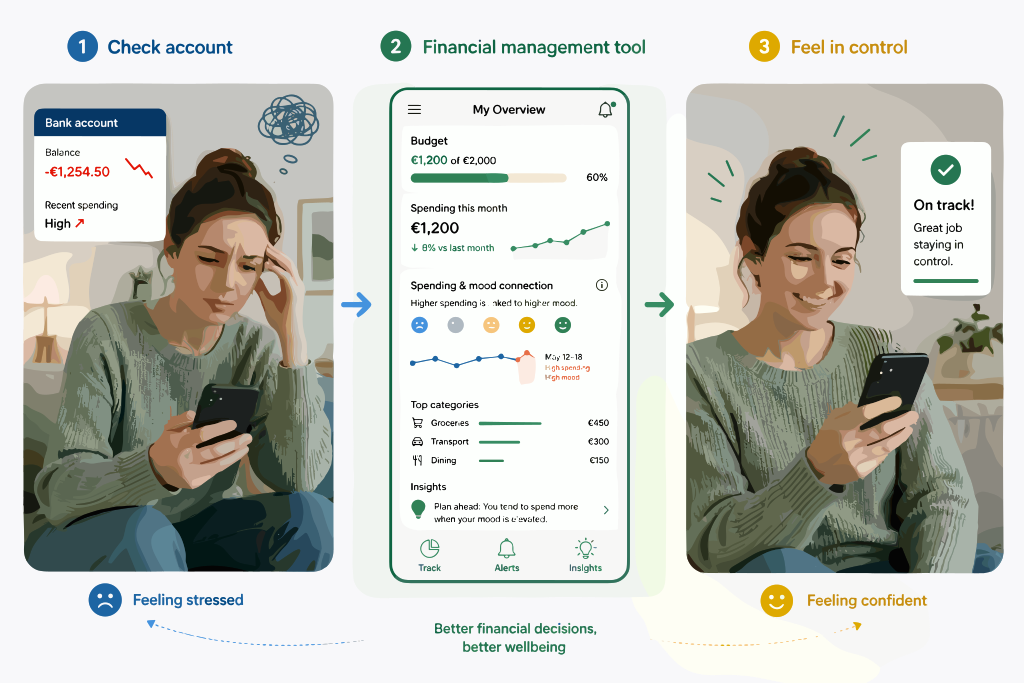
We use machine learning and statistical analysis to understand how financial behaviour and mental health are interconnected — and to build tools that help people with mental health conditions, particularly bipolar, help manage their finances better.
Based at the School of Computer Science, we partner with clinical institutions, financial services, and patient advocacy groups to conduct research that is rigorous, fair, and grounded in real-world impact.
Featured Research what we're working on.
All projectsFinHealth: Assessing Mood States from Financial Behaviour
activePeople with bipolar disorder may experience periods of high mood (mania) that can lead to impulsive spending and serious financial harm, including debt or bankruptcy. Current mood monitoring relies largely on self-report, which may miss early warning signs. This study explores whether patterns in bank transaction data—such as changes in spending—can help detect mood shifts earlier and support better financial management. Using anonymised transaction data and machine learning, we aim to identify links between financial behaviour and mental health outcomes, providing a foundation for future financial interventions for this vulnerable population.
Participatory Interview Study
completedThere is limited data and little research on identifying meaningful features for assessing mood from financial behaviour. This study addresses this gap using a human-centred, participant-informed approach that captures insights beyond those typically identified by clinical experts, while accounting for differences across geoeconomic regions to ensure broader applicability.
Recent News & publications.
Latest news
Our paper A Computational Ethical Framework for Financial Digital Phenotyping for Mental Health has been accepted for presentation at the 21st International Conference on Computational Intelligence Methods for Bioinformatics and Biostatistics (CIBB 2026)
Our paper Money and Mental Health: A Scoping Review of Financial Variables, Data sources, and Analytical Methods was accepted for publication in Frontiers in Public Health
Our paper Manifestations of Mood in Money: Unravelling Financial Behaviours for Passive Assessment in Bipolar Disorder was accepted at the 20th EAI International Conference on Pervasive Computing Technologies for Healthcare.
Our paper Money and Mental Health: Spending as a Mental Health Indicator - Psychological, Behavioral, Economic Perspectives and Data Collection was accepted at CHI 2025 The Future of Money and HCI.
Featured publications
All publications →Money and Mental Health: A Scoping Review of Financial Variables, Data Sources, and Analytical Methods
Oluwadara Adedeji, Andreas Balaskas, David Coyle, et al.
Frontiers in Public Health
The relationship between financial circumstances and mental health is well-established. New financial data sources such as bank transactions and digital payments offer new opportunities to better characterise this relationship. However, the prior financial data sources and analytical approaches have not been systematically reviewed. Understanding these is essential to guide future research and inform integrated interventions that address both financial and mental health outcomes. This scoping review systematically maps the research on money and mental health, examining: (1) the financial variables and data sources used, (2) modeling methods employed, and (3) methodological gaps that novel objective data might address. We systematically searched PubMed, PsycINFO, IEEE Xplore, ACM Digital Library, and Scopus. Papers were screened against predefined inclusion/exclusion criteria, and data extracted using a standardized spreadsheet. Analysis employed deductive coding guided by our research questions, refined iteratively through engagement with the data. PRISMA Extension for Scoping Reviews (PRISMA-ScR) was followed for reporting. Of the 43 included studies, most (n = 34, 79%) examined mental health in connection with financial factors such as financial difficulty or financial strain, while a small number focused on predictive modeling with financial behavioral data (n = 5, 12%), macroeconomic indicators (n = 2, 5%), or intergenerational support between parent and child (n = 2, 5%). Depression was the most common outcome (n = 24, 56%), followed by anxiety, psychological distress, and bipolar disorder. Statistical methods dominated (77%), with 19% employing machine learning or deep learning. Ground truths relied predominantly on self-reported questionnaires—only four studies used objective financial data (three gambling records, one bank transaction). This review reinforces the complex, bidirectional relationship between financial circumstances and mental health. Most studies examined how financial difficulty affects mental health, while only a few explored how mental illness influences financial behavior, indicating a clear research gap. There is substantial opportunity to use objective financial data and more diverse analytical methods, particularly machine learning, to deepen understanding of the relationship and interactions between money and mental health and inform targeted interventions.
Manifestations of Mood in Money: Unravelling Financial Behaviours for Passive Assessment in Bipolar Disorder
Oluwadara Adedeji, John Olusegun, Keith Gaynor, Mark Matthews
Pervasive Health 2026
Mood and money are closely intertwined in bipolar disorder (BD), yet it remains unclear whether financial behaviour provides reliable mood-contingent signals, and it is largely absent from digital phenotyping research. Advances in open banking enable objective, passive measurement of financial behaviour at scale. We conducted semi-structured interviews with 19 (11 UK, 4 Ireland, 4 Nigeria) adults with BD to examine how mood manifests in financial behaviour, identify potential financial mood markers, and explore data-sharing preferences. Participants reported distinct mood-related changes in spending and reciprocal effects of money on mood. Three themes emerged: (i) symptomatic drivers shaped by credit access, seasonality, and social context; (ii) candidate markers such as transaction frequency, timing, category, and amount; and (iii) conditional willingness by most participants to share data influenced by privacy, anonymity, and granularity. High-mood spending reflected goal pursuit, generosity, and insomnia, while depression involved both reduced spending and retail therapy, challenging simple bidirectional assumptions. These findings provide empirical insight into financial data as a potential mood marker and inform future research and privacy-sensitive data collection.